Fetal Alcohol Syndrome
Fetal Alcohol Syndrome (FAS) is a lifelong yet completely preventable set of physical, mental and neurobehavioral birth defects associated with alcohol consumption during pregnancy. FAS is the leading known cause of mental retardation and birth defects.
When a pregnant woman drinks alcohol, so does her baby; through the blood vessels in the placenta, the mother’s blood supplies the developing baby with nourishment and oxygen. If the mother drinks alcohol, the alcohol enters her blood stream and then, through the placenta, enters the blood supply of the growing baby.
Alcohol is a teratogen, a substance known to be toxic to human development. Depending on the amount, timing and pattern of use, if alcohol reaches the growing baby’s blood supply, it can interfere with healthy development. If a woman drinks wine, beer or liquor when she is pregnant, her baby could be born with FAS.
Prenatal alcohol exposure does not always result in FAS—although there is no known safe level of alcohol consumption during pregnancy. Most individuals affected by alcohol exposure before birth do not have the characteristic facial abnormalities and growth retardation identified with FAS, yet they have brain and other impairments that are just as significant.
Alcohol-Related Neurodevelopmental Disorder (ARND) describes the functional or mental impairments linked to prenatal alcohol exposure, and Alcohol-Related Birth Defects (ARBD) describes malformations in the skeletal and major organ systems.
Individuals with FAS have a distinct pattern of facial abnormalities, growth deficiency and evidence of central nervous system dysfunction. In addition to mental retardation, individuals with FAS, ARND and ARBD may have other neurological deficits such as poor motor skills and hand-eye coordination. They may also have a complex pattern of behavioral and learning problems, including difficulties with memory, attention and judgment.
As many as 12,000 infants are born each year with FAS and three times as many have ARND or ARBD. FAS, ARND and ARBD affect more newborns every year than Down syndrome, cystic fibrosis, spina bifida and Sudden Infant Death Syndrome combined. FAS, ARND and ARBD are 100% preventable when a woman completely abstains from alcohol during her pregnancy.
The incidence (number of new cases each year) of FAS and FAE are significantly under-reported. Therefore, projections are usually based on estimates of their occurrence per 1,000 live births. Recent studies by researchers Ernest Abel and Robert Sokol suggest that the incidence of FAS can conservatively be estimated at 0.33 cases per 1,000 live births. Missouri recorded 78,468 live births in 1991 and 76,005 in 1992, which would yield at least 25 new cases of FAS per year. The incidence of FAE is generally regarded to be several times the magnitude of FAS cases, perhaps in the hundreds in Missouri.
- Growth deficiencies: small body size and weight, slower than normal development and failure to catch up.
- Skeletal deformities: deformed ribs and sternum; curved spine; hip dislocations; bent, fused, webbed, or missing fingers or toes; limited movement of joints; small head.
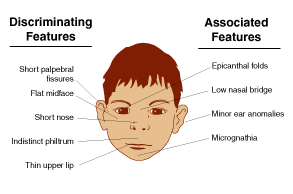
- Facial abnormalities: small eye openings; skin webbing between eyes and base of nose; drooping eyelids; nearsightedness; failure of eyes to move in same direction; short upturned nose; sunken nasal bridge; flat or absent groove between nose and upper lip; thin upper lip; opening in roof of mouth; small jaw; low-set or poorly formed ears.
- Organ deformities: heart defects; heart murmurs; genital malformations; kidney and urinary defects.
- Central nervous system handicaps: small brain; faulty arrangement of brain cells and connective tissue; mental retardation -- usually mild to moderate but occasionally severe; learning disabilities; short attention span; irritability in infancy; hyperactivity in childhood; poor body, hand, and finger coordination.
- poor coordination
- hyperactive behavior
- learning disabilities
- developmental disabilities (e.g., speech and language delays)
- mental retardation or low IQ
- problems with daily living
- poor reasoning and judgment skills
- sleep and sucking disturbances in infancy
 |
 |
 |